Introduction
Agricultural products often move through several stages between harvest and final consumption. Cleaning, sorting, cutting, drying, packaging, storage, and further processing can all influence the usability and value of a product. Among these stages, moisture reduction is particularly important for many products because it changes the physical condition of the material and can support storage or further processing when properly managed.
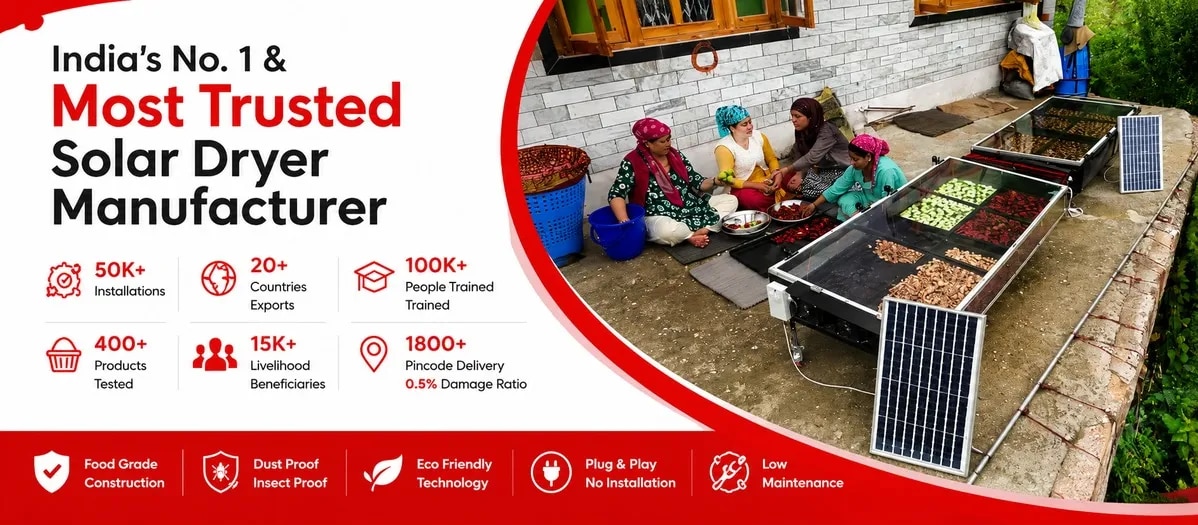
Solar drying provides a method of using sunlight as the primary thermal energy source. Modern solar drying equipment places the product inside an enclosed chamber instead of leaving it exposed directly to the outdoor environment.
Rudra Solar Energy develops and manufactures solar thermal equipment and offers solar dryers for a range of agricultural and food-processing applications. Its current solar dryer range includes models from small batch configurations through systems reaching 500 kg per batch, along with larger tunnel drying options.
Solar Drying as an Agricultural Processing Method
Drying has been used for generations to reduce moisture in agricultural products. Modern equipment changes how that process is managed.A solar drying machine can provide a defined chamber, organised tray loading, and controlled or assisted airflow depending on the configuration. This creates a more structured process than simply placing products outdoors.
The Importance of Moisture Reduction
Moisture affects the stability and handling of many agricultural products. The appropriate final moisture condition depends on the commodity and intended use.A product intended for long-term storage may have different requirements from one intended for immediate further processing. Therefore, drying targets should be established according to the product and application.
Different Types of Solar Drying Applications
There is no single universal solar dryer for every material. Different applications may require different configurations.Rudra Solar Energy provides dedicated or application-specific options for fruits, vegetables, spices, herbs, fish, grains, pulses, flowers, oilseeds, seeds, and cash crops.
It also describes a solar agricultural products dryer designed for suitable multi-commodity processing.
Why Product Specificity Matters
A chilli, a fruit slice, a grain, and a leafy herb do not behave identically during drying. Their dimensions, moisture content, surface characteristics, and desired final condition can differ considerably.For this reason, selecting equipment should begin with the material rather than simply searching for a generic solar dryer.
Benefits of Enclosed Solar Processing
An enclosed drying chamber can create a cleaner and more organised environment than open-sun drying. Rudra Solar Energy states that its cabinet dryer helps reduce direct exposure to dust, insects, birds, and sudden rainfall. :contentReference[oaicite:34]index=34This can be particularly useful when the business needs consistent handling practices.
Organised Tray Loading
Tray-based systems allow material to be distributed across defined surfaces. Good loading practices can help airflow reach the product more consistently.The operator must Click Here still follow the appropriate loading recommendations for the specific commodity. Overloading or uneven distribution can affect drying performance.
Who Can Use Solar Drying Equipment?
Solar drying can be relevant to several groups involved in agricultural processing.These may include:
- Individual farmers
- Farmer producer organisations
- Self-help groups
- Rural entrepreneurs
- Food-processing MSMEs
- Cooperatives
- Commercial agricultural processors
- Institutions and common processing centres
Rudra Solar Energy's location information specifically identifies farmers, FPOs, SHGs, tribal producer groups, cooperatives, rural entrepreneurs, MSMEs, and food-processing businesses among potential users of its solar drying solutions.
Building a Practical Processing Workflow
A dryer works best when it is integrated into a planned process.Before drying, the raw material may need sorting, cleaning, washing where appropriate, peeling, slicing, grading, or another preparation step. The correct preparation depends on the commodity.
After drying, the product may require cooling, inspection, packaging, and storage.
A Basic Workflow
A general processing sequence can include:- Receive and inspect the raw material
- Clean and prepare the product
- Cut or size the material where required
- Load trays according to the selected process
- Run the solar drying cycle
- Check the desired final condition
- Cool the dried material appropriately
- Package and store the finished product
This workflow should be adapted to the actual product and applicable food-processing requirements.
Capacity Planning for Different Operations
Rudra Solar Energy states that its solar dryer range includes capacities from 5 kg per batch to 500 kg per batch. :contentReference[oaicite:36]index=36 This range allows businesses with different processing scales to consider different configurations.However, capacity alone does not determine actual throughput. The product's moisture level, preparation, loading depth, weather conditions, airflow, and drying target all affect processing.
Small Processing Units
A small food entrepreneur may start with a lower-capacity cabinet dryer to process limited batches and develop a product line.Commercial Processing
An established processor or FPO may require a larger configuration or a commercial tunnel system depending on its throughput and workflow.The appropriate choice should follow a technical assessment rather than a simple comparison of capacity numbers.
Solar Drying and Sustainability
One reason solar drying attracts attention is its use of solar thermal energy. Rudra Solar Energy describes its solar dryer systems as using solar heat and also offers configurations with optional backup systems where required. :contentReference[oaicite:37]index=37The environmental and operating characteristics of a particular installation depend on how it is configured and operated. Businesses should therefore evaluate their actual energy requirements rather than assuming every drying application will operate identically.
Important Considerations Before Purchase
A potential buyer should collect enough information before requesting Solar Drying Machine a dryer recommendation.Useful information includes:
- Exact product name
- Fresh quantity available
- Initial moisture condition if known
- Desired final moisture condition
- Product size or slice thickness
- Required batches per day
- Processing season
- Available installation area
- Electricity availability
- Need for backup operation
Rudra Solar Energy's location guidance recommends sharing similar technical and operational details for customised evaluation.
Conclusion
Solar drying Know More can connect renewable thermal energy with agricultural processing in a practical way. By moving suitable products into an enclosed drying chamber, businesses can create a more organised alternative to open-sun drying.Rudra Solar Energy offers a broad solar dryer range for agricultural, food-processing, and other suitable applications. The company also provides product-specific systems and configurations, which reflects an important principle in drying technology: different materials require different process considerations.
For anyone evaluating a solar dehydrator or commercial solar drying machine, the best starting point is a clear understanding of the product, quantity, moisture condition, processing schedule, site, and desired finished product. With those details established, the appropriate equipment can be evaluated more accurately and integrated into a complete agricultural or food-processing workflow.